11 May 2015

Just in time for my roses!

Those of you who know me will know that I'm rose-obsessed.

Over the last few weeks I've been worried that my 15 climbers and bushes would bloom before I returned to Italy.

Whilst in Australia, I emailed my friends regularly with demands for "The Status of the Roses".

Every response threatened progress:

- "They have green shoots" or

- "The buds are just forming" or

- "The flowers will be blooming within days" or

- "Here's a photo of my first rose"

This last response, received when I was 16,000 kilometres away, sent me into waves of panic: Would I make it home in time!?

It seems I did...

My most advanced climber has been flowering profusely over the last few days and the first of my bush roses bloomed today.


Found: gooseberries

To Stu's immense relief, today we found his 6 little gooseberry bushes buried amidst our jungle!

A few little fruit are already hanging off them so he has put borders around the plants to protect them.

I am so excited at the thought of gooseberry pie...but it remains to be seen if the fruit actually makes it into the kitchen!

Gooseberries are a bit like peas when it comes to Stu's ability to wait until they're cooked...


09 May 2015

Our garden is a jungle

After being in Australia for 5 weeks, we returned a few days ago to a veritable jungle in our little valley.

Spring has brought rain and heat, a combination that encourages phenomenal growth here.

I managed to weed half the garden today and will do the other half tomorrow. Stu has been busy with the lawn mower and whipper snipper (translation: "weed wacker" for our American friends or "strimmer" for our English friends).

We are keen to get it under control and beautiful again so that we can sit in our new/old fienile and enjoy it!

Above: My pergola garden where the plants are lost amongst the weeds

Above: The first of many wheelbarrows full of weeds

Above: We won't mow our paddocks yet; we'll let the bees and butterflies frollick amongst the wild flowers a bit longer!


Casting off in "Castaway"

We have just spent 5 weeks in Australia (hence the recent lack of posts...)

While we were there we took possession of our "home away from home", a Toyota Coaster bus which we have had converted into a mobile home.

We engaged a small company in Brisbane (Motorhome Conversions) to import the bus from Japan and fit it out as a motorhome for us. It has a kitchen, lounge/dining, bathroom and bedroom and Is surprisingly spacious and very comfortable.

We named our little bus "Castaway" and drove it 1500km from Toowoomba to Rockhampton and back for its first little spin.

All went well and it was lovely having our own space.

Castaway is now in storage until our next visit...

Above: Our first bush camp

Above: Washing the bus before putting it into storage
Above: Farewelling the bus at the storage shed


08 May 2015

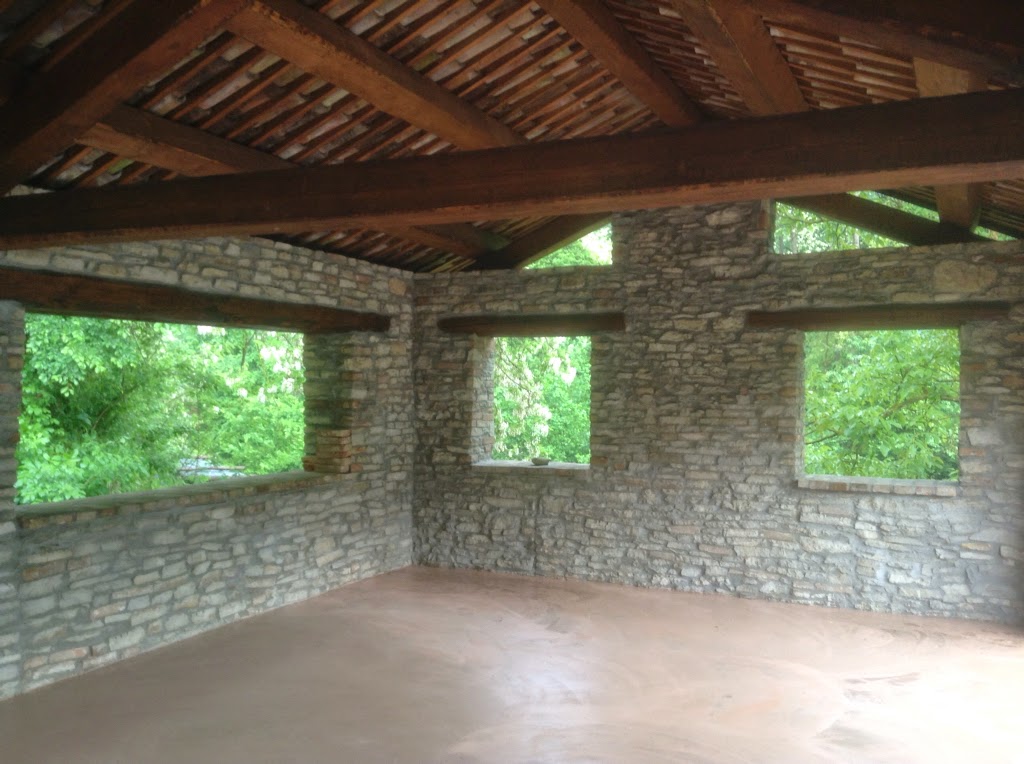
Fienile renovation...the result!

The renovation of our beautiful old fienile is finished...and it's everything we had imagined it could be...


02 April 2015

Fienile renovation...the openings have been created

Over the last couple of days Sandro has been shaping the various openings in the upper fienile.

He had previously installed huge wooden beams above each opening in order to support the stonework above and around the spaces. These beams are 3 deep because the stone walls are about half a metre thick. The addition of this wood creates authenticity and complements the house, which also has wooden beams over its windows and doors.

To shape the openings, Sandro has been removing stones.

First he shaped the entry space into the upper level of the fienile. It used to be a narrow opening that we would creep through, careful to watch for a snake, lizard or scorpion that might be lying in wait between the haphazard stones.

Next he removed stones from the end wall of the fienile to make two openings. These will enable us to look out over our plum and hazelnut groves, vegetable garden, gooseberry plot, kiwi vines, strawberry barrel, woodpile and the creek.

Then he removed stones from the back wall of the fienile to make a long opening which will allow air to flow through the space. This will be important given that we plan to use our wood-fired pizza oven and BBQ up there.

After roughly shaping these openings, he hung string lines on each side of them which will guide him as he rebuilds the jagged stonework into even shapes. Then he used a jackhammer to remove patches of old cement and plaster from the stone walls. They are now clean and ready for pointing.

I took the opportunity to ask Sandro how stone buildings were constructed 200-300 years ago when the fienile was first built and before cement was commonplace. The stones in our walls had been beautifully laid by a craftsperson of old but there was a lot of dirt and dust between them and I wondered if the dirt had been placed deliberately or collected over time (a natural assumption in a farming region).

Sandro explained verbally but also visually in the manner of a man who is used to working with his hands. We were crouched on the ground near his cement bucket. He leaned over, picked up a handful of tufa dust that had been dampened by recent rain. He moulded it in his palm much like a potter might mould clay before throwing it on a wheel. Then he slapped it down on the ground, smoothed it flat with a quick stroke of his trowel, then placed a stone on it. This "glue" was nicely sticky and would obviously be effective for many years. I remembered the mud bricks that I had previously found amongst the stones in our walls.

I continue to be fascinated by the traditions and resourcefulness that this old building and our skilled muratore share with me.

Our buildings surround me in natural materials, colours and textures. I smell the cool of the stones, the mud of the dirt and the spice of the wood. Our land encases me in explosive shapes and colours. I see new tender leaves emerging and smell the perfumes of blossoms and bulbs.

I quite simply love the "earthiness" of my life here...


01 April 2015

Fienile renovation...the upper lacework is down

With the roof finished and the stone pointing on the upper outside walls completed, Sandro has been able to dismantle the upper inner and outer scaffolding.

This means that, for the first time, we've been able to walk into the fienile and truly appreciate the roof structure.

We've been able to "feel" the place...and it feels very very good...


31 March 2015

Fienile renovation...we have a roof!

We have a roof!

The rafters were brought up by the lifting mechanism and placed on the beams using a very fast process of lift, measure, nail...lift, measure, nail...

The terracotta tiles were placed in much the same way: lift, fit tile clip, place tile...lift, fit tile clip, place tile...

In no time at all the entire roof was striped in rafters and decorated with our lovely old re-used multi coloured terracotta tiles...


29 March 2015

Fienile renovation...the earthquake ring is in place

This week we had a few rainy days which delayed work.

A giant tarpaulin had to be stretched over the roof structure in order to protect the wooden beams and the half-finished earthquake ring.

Despite the cold and wet, Sandro continued to arrive alone and work under the tarpaulin.

He had been making a bit of destructive stone-like noise on the upper internal scaffold so I went up to see how he was busying himself. To access this area, you need to climb a ladder and as I arrived on the scaffold I was surprised to see how protected and peaceful it was up there under the tarp. The tarpaulin shielded the area from the wind and made the dismal damp precipitation sound like gentle joyful raindrops on a tent!

Sandro had spent a few hours creating two holes in the end wall which will ultimately be windows. He had been gathering the rocks from these holes and placing them closer to his next area of focus: the earthquake ring at the other end of the fienile.

The absence of rain the next day saw the complete team arrive with renewed enthusiasm. They spent the day finishing the earthquake ring, the stonework around the ring as well as pointing the internal walls.

A muratore in action is a fascinating thing to watch.

It is the stuff of history, tradition and art.

I am in awe.

Sandro has few tools and does everything by hand. A string line, a bucket of cement, a trowel, a strange blade that looks like an overgrown meat cleaver and a hammer. He works quickly, picking up a stone and whacking it with the meat cleaver to shape it for the space he has to fill. Like an artist, he rarely looks twice at the space he has to fill; it is as if he takes a mental photograph of the space and then focuses on the stone. It seems that the shape he creates is never wrong. When he's happy with it, he slices a piece of thick oozey cement out of his bucket, throws it on the top of the wall and smoothes it quickly with a deft movement of the wrist. Then he places his newly shaped stone on the cement and hammers it gently so that it is level with the rest of the wall.

While Sandro was doing this, another member of his team was pointing internal stonework. This is also fascinating. The cement is thrown at the wall, onto the stone and the gaps, then partially trowelled off. It looks awfully messy. But a few hours later, when the cement is partially dry, a wire brush is used to remove the excess and highlight the stonework.

Having tried to fill various holes in our stonework using my own form of stone masonry, I can confidentally state that it is impossible. I could never find the perfect stone to fit my space and spent more time carrying stones around than doing actually anything with them! If I was lucky enough to find the perfect stone, the cement I threw at the wall usually landed on the ground and if I was lucky enough to actually place a stone it usually fell out immediately.

I am in awe.


28 March 2015

Fienile renovation...the "antico" plates

When our muratore arrived yesterday, he had a set of steel plates with him.

Within seconds of diving out of his truck, he had broken the tranquillity of the valley and was making noises with a grinder.

I peered out to see what he was doing and found him cutting into the plates, loudly ruining their smooth appearance. When I asked what he was doing, he explained that he was giving them an antique or "stressed" look.

This is yet another of Sandro's ideas that go above and beyond the call of duty. We continue to be amazed and grateful that he cares so much about our building.

The newly aged plates will go on the roof peaks and joins and add to the authentic rustic feel of the building.

After he finished grinding them, he presented them to us for rust proofing.

Stu's hanging apparatus (which allowed us to paint both sides of the plates easily) was a stark contrast to the antique plates. It looked like a weird modern art installation!


27 March 2015

Traditions are wonderfully alive here

Our muratore arrives every morning in a small truck with his two workers.

As I watched them arrive this morning, it occurred to me that I was watching something deeply traditional. The work they do is clearly an ancient craft but the work culture they have is also old.

In Australia, workers generally arrive at a job site in their own vehicles and are essentially independent of the boss.

In Italy they arrive together, smiling and laughing. During the day, they are constantly talking and coordinating, always looking for opportunities to help each other. There is a "togetherness" which I can only assume comes from an old culture that respects family and community.

There is somehow a sense of intimacy.

I have to keep pinching myself to ensure that I never take this wonderful Italian culture for granted...

24 March 2015

Fienile renovation...the gaps have been framed

When it is finished, the second storey of the fienile will be an light and airy entertainment area. There will be open spaces in each wall which will allow good airflow and enable the property to be viewed from various angles.

For the last two days our muratore has been installing the earthquake ring and tidying up the stonework.

This has involved lifting steel reinforcing up to the roof, then bending it and tying it together in a cube shape which fits between the inner and outer stones of each wall.

Once this boxing is in place, the stonework around it is built up, levelled, tidied and pointed, then cement is poured into the framework.

The team of 3 worked in the sun yesterday...and in the rain today.

The giant tarpaulin that covers the entire roof is coming in very handy!